
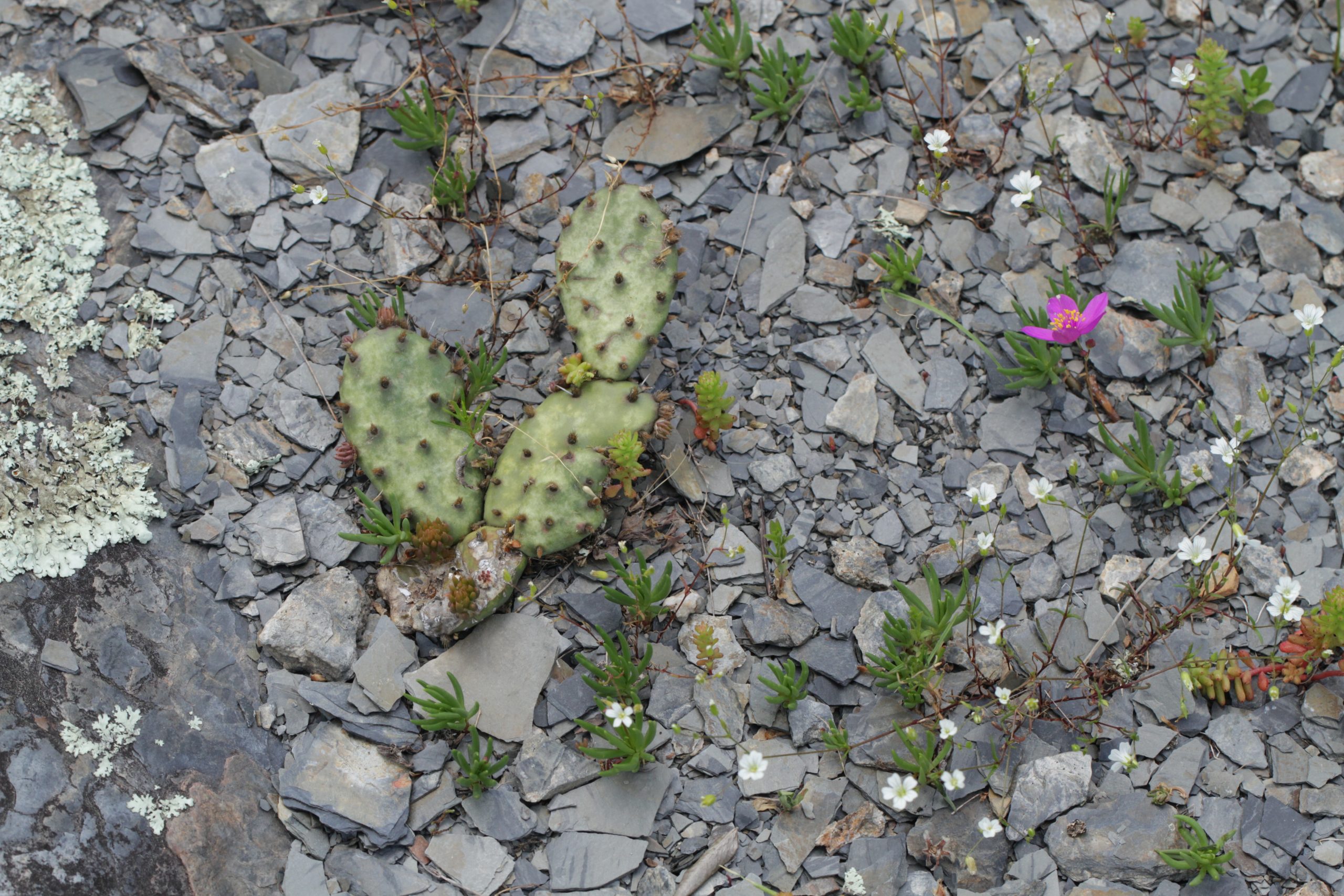
Shale glades are by far the most unique ecosystem in Arkansas, and most people don’t even know of their existence. Their thin soils create islands of unique grasslands dotted all over the Ouachita Mountains and are home to rare native succulents, cacti, undescribed species, and pollinators. The glades here are some of the rarest ecosystems in the world. All different types can be found across the southeastern United States, differing in geology, chemistry, and environments. In the spring, the annuals erupt in vibrant yellows, blues, and whites, which I have yet to photograph. The Open habitat allows nectar-rich plants to thrive, supporting butterflies like the Diana Fritillary, Monarch, and Southern Plains Bumblebee. But much like the grasslands of the south, they are vastly underfunded and researched. Without a natural fire regimen, these places get overrun by eastern red cedar (Juniperus virginiana) and are some of the most endangered ecosystems in the world.
Harsh Geology of Glades
Glades occur on flat rock exposures that form from wide sweeping hills. In central Arkansas, the most common types you’ll find in Central Arkansas are Nepheline Syenite glades on the Igneous exposures and shale glades on the Ordovician silicic deposits, aka shale, as seen above. Because they are most often found at the bottom of slopes, they remain wet but only during the wet season. When summer hits, it dries out, turning super hot and barren.


Succulents in Arkansas

Fameflowers (Phemeranthus) have succulent leaves that efficiently hold water and take advantage of the rocky substrate that weeds out the more aggressive species. The flowers also only bloom from 1 pm to 7 pm to preserve pollen and nectar.
This is actually an undescribed Fameflower (Phemeranthus) species thought to be common on Ouachita shale glades. It has way too many sepals and shiny black seeds that separate it from the two other undescribed species here. Currently, it keys most closely to Large-flowered Fameflower (Phemeranthus calycinus) but is possibly more related to Menges’ Fameflower (Phemeranthus mengesii)


hydroxeric ANNUALS

The hydroxeric nature of glades causes annuals like Nuttall’s Cornsalad (Valerianella nuttallii) and Pitcher’s Stitchwort (Mononeuria patula) to adapt to the wet season. Because of this, they are extremely susceptible to drought. This is especially the case with our Saline County endemic Pelton’s Rose-Gentian (Sabatia arkansana). Some years, you’ll struggle to find 1 specimen during a drought. With good rain, you’ll see thousands.
With the drier environment, you’ll often see more western species like this Comanche Western Daisy (Astranthium ciliatum) taking advantage of the shallow soil.

Glades and barrens
Shale glades are not lifeless ecosystems; in fact, quite the opposite. Glades open up and allow light for grassland plants, which in turn support beneficial insects. Southern Plains Bumble Bee (Bombus fraternus) targets Tall Green Milkweed (Asclepias hirtella) and Spider Milkweed (Asclepias viridis), most likely because of the inferred color on the flowers. Our state butterfly, the Diana Fritillary (Argynnis diana), can commonly be found on the Ouachita beebalm in May. In fact, Argynnis diana only nectar on a few species, and they can all be found on these shale glades. Scorpions and rattlesnakes, and many lizards, favor the dry environment. Glades are exploding with life and are worth protecting.


Leave a Reply